In 2026, the conversation about workplace design has shifted in a significant and overdue direction. For years, open-plan offices were celebrated for their collaborative energy, visual openness, and space efficiency — and the noise that came with them was treated as an acceptable trade-off, a minor inconvenience that employees were expected to manage with headphones or personal discipline. That framing is no longer sustainable. Research across workplace psychology, occupational health, and organizational productivity has converged on a consistent finding: uncontrolled office noise is not a comfort issue — it is a performance issue, a retention issue, and increasingly, a burnout issue.
In open-plan workplaces, sound reflections from hard ceilings, glass partitions, concrete floors, and large shared surfaces create long reverberation times that make speech intelligibility poor, concentration difficult, and sustained deep work nearly impossible. Employees in high-noise environments report higher levels of cognitive fatigue, lower perceived privacy, more frequent task-switching interruptions, and greater difficulty communicating clearly in both formal and informal settings. The cumulative effect on productivity, engagement, and employee well-being is measurable — and it is costing organizations more than most facility managers realize.
Acoustic baffles offer a practical, design-compatible, and commercially scalable solution to this problem. As suspended sound-absorbing elements installed from the ceiling, acoustic baffles increase the total sound-absorbing surface area of an open office without consuming wall space, floor area, or visual openness. For office designers and facility managers comparing hanging ceiling baffles, Acousound provides suspended acoustic solutions designed to reduce echo, improve indoor acoustic comfort, and support quieter, more focused environments across open workspaces, meeting zones, reception areas, and collaborative spaces.
This guide covers the complete picture for workplace designers and facility decision-makers: why office noise has become a human capital investment issue in 2026, how acoustic baffles work to reduce reverberation and improve speech clarity, what design components determine acoustic performance, how baffles compare to other open office noise solutions, and what planning and maintenance practices ensure long-term acoustic performance. Secondary keywords relevant to this decision — office acoustic baffles, open office noise solutions, ceiling baffles for productivity, and commercial sound absorption — are addressed throughout.
To understand why acoustic baffles have moved from a niche acoustic product to a mainstream workplace investment in 2026, it helps to start with a clear picture of what uncontrolled office noise actually does to the people who work in it — and why the consequences have become commercially significant enough to change how organizations think about facility investment.
Open-plan offices are designed to facilitate collaboration, spontaneous communication, and team cohesion. These are genuine benefits — but they come with an acoustic cost that the original open-plan design philosophy consistently underestimated. When dozens or hundreds of people share an undivided space, the cumulative sound energy from conversations, phone calls, keyboard activity, meeting spillover, and movement creates a continuous background noise level that competes directly with the cognitive demands of focused work.
The specific mechanism by which noise impairs productivity is well-documented. When the brain is exposed to intelligible speech — conversations that are audible but not directed at the listener — it involuntarily allocates cognitive resources to processing the speech content, even when the listener is actively trying to ignore it. This involuntary attention capture reduces the cognitive bandwidth available for the primary task, increasing error rates, slowing processing speed, and making complex analytical work significantly more difficult. The effect is most pronounced for tasks that require sustained concentration, language processing, or working memory — precisely the tasks that knowledge workers perform most of the time.
Beyond the direct productivity impact, sustained exposure to high-noise environments creates acoustic fatigue — a form of cognitive and physiological exhaustion that accumulates over the working day and contributes to the broader burnout patterns that organizations are increasingly recognizing as a retention and engagement risk. Employees who consistently find their workplace acoustically uncomfortable are more likely to seek quieter alternatives — remote work, private offices, or employment elsewhere — than to adapt to the noise.
The conventional response to open office noise has focused on wall-mounted acoustic panels, desk screens, and soft furnishings — all of which contribute to sound absorption but are limited by the available surface area they can cover. In large open offices with glass partitions, exposed brick, polished concrete, and minimal soft furnishings, the wall and floor surfaces available for acoustic treatment are often insufficient to achieve meaningful reverberation reduction.
The ceiling is the largest continuous surface in most open offices — and in the typical open-plan environment, it is also the most acoustically reflective. Exposed concrete slab ceilings, metal deck ceilings, and even standard acoustic tile ceilings with limited absorption coefficients allow sound energy to reflect repeatedly between the ceiling and the floor, creating the long reverberation times that make open offices acoustically uncomfortable. Hanging ceiling baffles address this problem directly by converting the ceiling zone from a reflective surface into an absorptive one — without reducing usable floor area, blocking natural light, or compromising the visual openness that open-plan design is intended to provide.
Office acoustic baffles are particularly effective in spaces with high ceilings — atriums, converted industrial buildings, modern headquarters with double-height volumes — where the ceiling surface area is large and the distance between the ceiling and the occupied zone creates strong reflections that wall panels cannot adequately address.
Understanding the acoustic mechanism by which hanging ceiling baffles reduce reverberation and improve speech clarity helps facility managers and designers evaluate acoustic baffle specifications against the actual performance requirements of their office environment.
Reverberation is the persistence of sound in a space after the original sound source has stopped. When someone speaks in a reverberant room, the sound energy bounces repeatedly between hard surfaces — ceiling, floor, walls, glass — before it is gradually absorbed. The reverberation time — typically measured as RT60, the time for the sound level to decay by 60 decibels — determines how long this persistence lasts. In a highly reverberant space, multiple reflections of the same speech signal arrive at the listener's ears at slightly different times, causing the speech to sound blurred, unclear, and difficult to understand.
For open offices, the target reverberation time depends on the size and use of the space, but most acoustic design guidelines recommend RT60 values in the range of 0.4 to 0.8 seconds for open-plan work environments. Many untreated open offices — particularly those with hard ceilings, glass partitions, and minimal soft furnishings — have reverberation times significantly above this range, which is why speech intelligibility is poor and noise levels feel subjectively high even when the actual sound pressure level is moderate.
Acoustic baffles improve room acoustics by absorbing sound energy at the ceiling level rather than allowing it to reflect back into the occupied space. The absorption mechanism works through the porous or fibrous structure of the baffle material: when sound waves enter the material, the air movement caused by the sound wave creates friction within the material's internal structure, converting the acoustic energy into a small amount of heat. This conversion reduces the energy of the reflected sound wave, shortening the reverberation time and improving speech clarity.
The suspended installation of hanging ceiling baffles provides a specific acoustic advantage over flat ceiling panels: both faces of the baffle are exposed to the sound field, and the edges of the baffle also contribute to absorption. This means that a suspended baffle provides more effective absorbing surface area per unit of ceiling coverage than a flat panel applied directly to the ceiling surface. The gap between the baffle and the hard ceiling above also influences absorption performance — a carefully planned suspension height can improve low-frequency absorption by creating a resonant air cavity between the baffle and the ceiling.
The relationship between reverberation time reduction and workplace performance is not merely theoretical — it is measurable through both acoustic testing and employee feedback. Studies of office acoustic interventions consistently show that reducing RT60 from above 1.0 seconds to below 0.6 seconds in open-plan environments produces measurable improvements in speech intelligibility scores, reductions in self-reported noise distraction, and improvements in employee satisfaction with the acoustic environment. These improvements translate into the productivity, focus, and communication quality outcomes that organizations are increasingly treating as human capital metrics rather than simply facility comfort indicators.
Ceiling baffles for productivity are most effective when they are specified and installed as part of a systematic acoustic design approach — with baffle density, layout, and suspension height calculated to achieve a target reverberation time rather than simply adding panels until the space looks acoustically treated.
A successful office acoustic baffle installation is a system of design decisions — material selection, panel geometry, suspension height, layout density, and visual integration — each of which affects both acoustic performance and the overall quality of the workplace environment. Understanding what each component contributes helps buyers specify acoustic baffles that deliver the performance they need while supporting the design intent of the space.
The acoustic performance of a baffle is determined primarily by its material composition and thickness. Common acoustic baffle materials include PET polyester fiber, fiberglass, mineral wool, and open-cell foam — each with different absorption coefficients across the frequency range, different weight and handling characteristics, and different sustainability and safety profiles.
PET polyester acoustic baffles — such as those in Acousound's product range — offer a combination of good broadband absorption performance, lightweight handling, durability, and environmental credentials that make them a popular choice for commercial office applications. Acousound's PET acoustic ceiling baffle products are available in customizable sizes, multiple thicknesses, and approximately 40 color options, with fire-class information and acoustic property data available for specification purposes — supporting both the performance and compliance requirements of commercial interior projects.
The geometry of the baffle — its height, width, and thickness — affects both its acoustic performance and its visual impact in the space. Taller baffles present more absorbing surface area to the sound field and are generally more effective per unit of ceiling coverage than shorter panels. Thicker baffles provide better low-frequency absorption, which is important in spaces where low-frequency reverberation from HVAC systems, footfall, or mechanical equipment contributes to the acoustic problem.
The suspension height — the distance between the bottom of the baffle and the hard ceiling above — should be planned carefully. A gap of 100 to 200 millimeters between the baffle and the ceiling is typically recommended to allow sound to reach both faces of the baffle and to create the air cavity that improves low-frequency absorption performance.
The total absorbing surface area provided by the baffle installation — determined by the number of baffles, their size, and their spacing — must be calculated to achieve the target reverberation time for the space. A common planning error is to install too few baffles, creating a visually present but acoustically insufficient treatment. Commercial sound absorption calculations should be performed before specifying the baffle layout, using the room volume, surface areas, and target RT60 to determine the required absorption area.
Zone-based layout planning — concentrating baffles more densely above the noisiest areas, such as high-density workstation clusters, meeting zones, and reception areas — is more effective than uniform distribution across the entire ceiling, because it addresses the acoustic problems where they are most severe.
| Component | Why It Matters | Design Consideration |
|---|---|---|
| Material | Determines absorption performance, weight, safety, and sustainability | PET polyester, fiberglass, mineral wool — match to performance and compliance requirements |
| Thickness | Affects absorption at different frequencies | Thicker panels improve low-frequency absorption |
| Panel size | Influences coverage and visual impact | Larger baffles provide more absorption per suspension point |
| Suspension height | Affects interaction with ceiling and low-frequency performance | Plan gap carefully — typically 100 to 200mm from hard ceiling |
| Spacing and layout density | Controls total absorbing surface area | Use denser layouts above noisiest zones |
| Color and shape | Supports interior branding and visual design | Acousound offers approximately 40 color options for design integration |
| Fire and safety rating | Essential for commercial interior compliance | Confirm fire class for workplace and building code requirements |
Different acoustic solutions address different aspects of the open office noise problem. Acoustic baffles are particularly effective for whole-room reverberation control in large open spaces, but they work best as part of a layered acoustic strategy that addresses both the reverberant field and the near-field noise environment at individual workstations.
Acoustic baffles — ceiling-based reverberation control
Hanging ceiling baffles are the most effective solution for reducing whole-room reverberation in large open offices, particularly those with high ceilings, exposed hard surfaces, and limited wall space for panel installation. Their suspended installation exposes both faces to the sound field, maximizing absorption per unit of ceiling coverage. They are visually flexible — available in a wide range of colors, sizes, and configurations — and can be integrated into the ceiling design as a deliberate aesthetic element rather than an afterthought. Their primary limitation is that they require ceiling suspension planning that must account for HVAC systems, sprinklers, lighting, and structural constraints.
Wall acoustic panels — enclosed space treatment
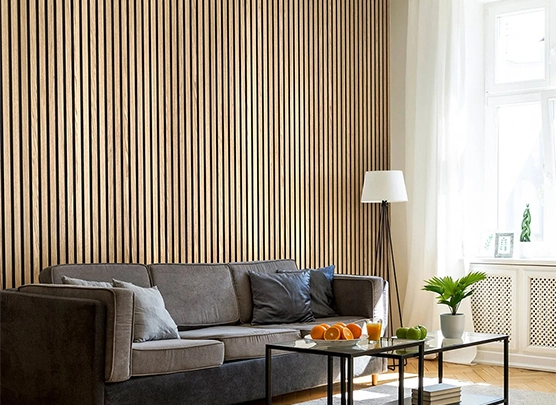
Wall panels are effective in meeting rooms, focus rooms, and enclosed offices where the wall surfaces are available and the room volume is small enough that wall-mounted absorption can achieve the target reverberation time. In large open offices with glass partitions, exposed brick, or limited solid wall area, wall panels alone are typically insufficient to achieve meaningful reverberation reduction.
Acoustic desk screens — near-field noise control
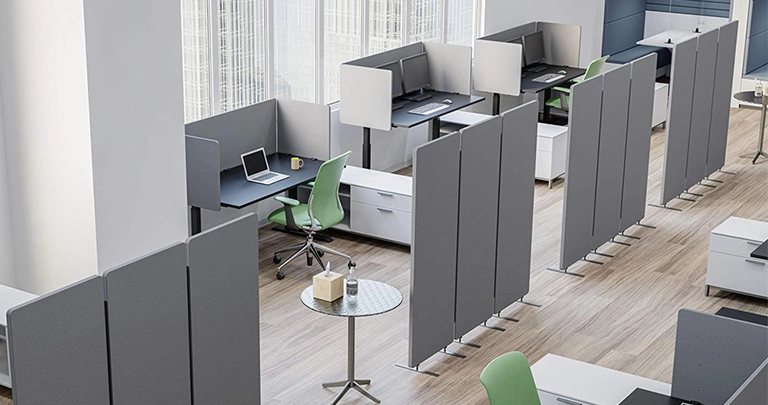
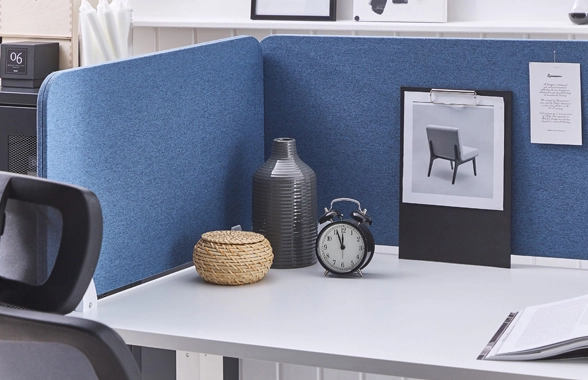
Desk screens address a different aspect of the noise problem: near-field speech privacy and visual separation between adjacent workstations. They reduce the direct sound path between neighboring desks but have limited effect on whole-room reverberation. They are most effective as a complement to ceiling-based treatment rather than as a standalone solution.
Acoustic ceiling clouds — horizontal ceiling absorption
Ceiling clouds are horizontal panels installed parallel to the ceiling, providing absorption from their lower face. They offer a clean, architectural appearance and are effective for reducing reflections from the ceiling directly above the installation area. Vertical baffles typically provide more absorption per unit of ceiling coverage than horizontal clouds because both faces are exposed to the sound field, but clouds may be preferred in spaces where the visual design requires a more planar ceiling treatment.
| Solution | Best Application | Primary Advantage | Key Limitation |
|---|---|---|---|
| Acoustic baffles | Open offices, atriums, collaboration areas, lobbies | High exposed surface area, strong reverberation control, design flexibility | Requires ceiling suspension planning |
| Wall acoustic panels | Meeting rooms, focus rooms, enclosed offices | Effective in smaller enclosed spaces | Limited when wall space is glass or occupied |
| Acoustic desk screens | Workstation privacy and near-field noise control | Improves local focus and visual privacy | Limited effect on whole-room reverberation |
| Acoustic ceiling clouds | Horizontal ceiling absorption, architectural integration | Clean appearance, broad absorption below installation | Less absorption per unit area than vertical baffles |
| Carpet and soft furnishings | General sound softening, footfall reduction | Adds comfort and reduces impact noise | Insufficient alone for large open office reverberation |
Office acoustic baffles are most valuable in environments where the combination of high occupancy density, hard surface finishes, and large open volumes creates severe reverberation problems: technology company open-plan headquarters, financial services trading floors, creative agency studios, co-working spaces, educational institution open learning areas, healthcare administration offices, and hospitality venues with large public areas. In all of these environments, the ceiling is the primary available surface for acoustic treatment, and hanging ceiling baffles provide the most practical and design-compatible path to meaningful reverberation reduction.
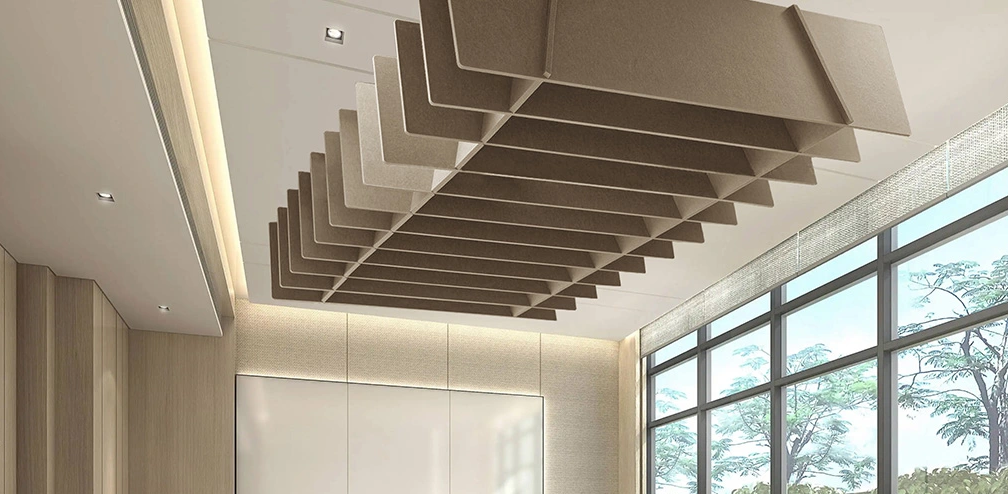
Specifying and installing acoustic baffles that deliver measurable acoustic improvement — and that maintain their performance and appearance over the long term — requires systematic planning before installation and consistent maintenance practices afterward.
Before selecting acoustic baffles for an office project, facility managers and designers should confirm the following:
Define the primary acoustic problem: excessive reverberation, speech distraction, meeting noise spillover, or perceived lack of privacy — different problems may require different treatment strategies
Identify the zones that need treatment: open workstation areas, meeting zones, reception, cafeteria, corridors, or collaborative spaces — and prioritize by noise severity
Measure or estimate the current reverberation time in the space — this provides the baseline against which the acoustic improvement can be calculated and verified
Confirm the ceiling height and the available suspension zone — accounting for HVAC ducts, sprinkler heads, lighting fixtures, and structural elements that constrain baffle placement
Calculate the required absorption area to achieve the target reverberation time — this determines the number, size, and density of baffles needed
Select baffle material, thickness, and size based on the acoustic performance requirements and the frequency range of the primary noise problem
Confirm fire rating and indoor safety compliance requirements for the specific building and jurisdiction
Determine color and visual design requirements — confirm whether customization is needed to match the office interior design or brand identity
Confirm whether the installation can be performed without interrupting daily office operations — plan installation timing accordingly
Request layout guidance and acoustic performance calculations from the supplier before finalizing the specification
Converting acoustic baffle installation from a facility expense into a measurable human capital investment requires tracking performance metrics before and after installation:
Reverberation time measured at multiple points in the treated space before and after installation
Employee noise satisfaction survey scores — before and after installation, and at six-month intervals
Speech intelligibility scores in key work zones and meeting areas
Frequency and nature of noise-related complaints from employees and visitors
Usage patterns of quiet rooms and focus spaces — reduced demand may indicate improved acoustic comfort in the open office
Productivity-related workplace experience indicators from employee engagement surveys
Dust acoustic baffles regularly using a soft brush, vacuum with a brush attachment, or approved dry cleaning method — dust accumulation on the baffle surface can reduce absorption performance over time
Inspect suspension wires, hooks, ceiling anchors, and connection hardware at regular intervals — particularly after office renovations, ceiling work, or events that may have disturbed the installation
Avoid saturating acoustic materials with water or liquid cleaning agents — most acoustic baffle materials are not designed for wet cleaning and may be damaged by moisture
Replace panels that are visibly damaged, stained, or structurally compromised — damaged panels may have reduced acoustic performance and can affect the visual quality of the installation
Keep acoustic baffles away from heat sources, chemical exposure, and direct contact with HVAC discharge that could degrade the material over time
Check baffle alignment and suspension integrity after any ceiling work, HVAC maintenance, or office reconfiguration that involves work in the ceiling zone
Review the acoustic layout when office density, team configuration, or space usage changes significantly — a layout that was adequate for the original occupancy may need adjustment if the space is reconfigured
Maintain product specifications, installation records, and suspension hardware documentation for future facility management, warranty claims, and acoustic performance verification
In 2026, the organizations that are winning the talent and productivity competition are the ones that treat the physical workplace environment as a strategic asset — not just a cost center. Uncontrolled reverberation in open-plan offices is no longer an acceptable background condition. It is a measurable drag on focus, communication, privacy, and employee well-being that compounds over time into burnout, disengagement, and turnover costs that far exceed the investment required to address it.
Acoustic baffles provide a flexible, design-compatible, and commercially proven path to meaningful acoustic improvement in open offices of every scale and configuration. By increasing sound-absorbing surface area from the ceiling — the most underused acoustic surface in most open workplaces — hanging ceiling baffles reduce reverberation, improve speech clarity, and create the quieter, more focused environment that knowledge workers need to perform at their best. For companies planning office renovations, workplace upgrades, or new headquarters, office acoustic baffles represent one of the highest-ROI investments available in the commercial sound absorption category.
Acousound offers acoustic ceiling baffle systems, PET acoustic panels, office partitions, and custom acoustic products for commercial and residential spaces, with options for size customization, color selection across approximately 40 options, and architectural integration support for projects of every scale and design complexity.
Contact Acousound today to discuss your office layout, noise pain points, ceiling conditions, and design goals. The Acousound team can help you specify the right acoustic baffles and hanging ceiling baffle layout for your space — and provide the acoustic performance calculations and design guidance needed to turn your workplace acoustic investment into a measurable productivity outcome.
Q1: What are acoustic baffles and how do they differ from standard ceiling tiles?
Acoustic baffles are suspended sound-absorbing panels installed vertically from the ceiling, designed to reduce echo and reverberation in indoor spaces. Unlike standard ceiling tiles, which are installed horizontally and absorb sound only from their lower face, hanging ceiling baffles are suspended in the air with both faces and edges exposed to the sound field — providing significantly more effective absorbing surface area per unit of ceiling coverage. This makes them particularly effective for large open offices, atriums, and spaces with high ceilings where standard ceiling tiles alone cannot achieve adequate reverberation reduction.
Q2: Why are acoustic baffles particularly effective for open-plan office noise problems?
Open-plan offices typically have large volumes, hard reflective surfaces, and limited wall space for acoustic treatment — conditions that make ceiling-based absorption the most practical and effective approach to reverberation control. Office acoustic baffles address this by converting the ceiling zone from a reflective surface into an absorptive one, without reducing floor area, blocking natural light, or compromising the visual openness of the space. Their suspended installation exposes both faces to the sound field, maximizing absorption efficiency, and their design flexibility allows them to be integrated into the office aesthetic as a deliberate visual element.
Q3: How do hanging ceiling baffles improve employee productivity and well-being?
Hanging ceiling baffles improve productivity and well-being by reducing the reverberation time in the open office — shortening the persistence of reflected sound that makes speech intelligibility poor and sustained concentration difficult. When reverberation is reduced, employees experience less cognitive fatigue from involuntary speech processing, better speech clarity in conversations and meetings, improved perceived privacy between adjacent work areas, and a generally more comfortable acoustic environment. These improvements translate into measurable outcomes including reduced noise complaints, better focus scores in employee surveys, and improved performance on tasks requiring sustained concentration.
Q4: How many acoustic baffles does an open office need to achieve meaningful noise reduction?
The number of baffles required depends on the room volume, the current reverberation time, the target reverberation time, the size and absorption coefficient of the selected baffle, and the layout density. A systematic acoustic calculation — using the room dimensions, surface areas, and target RT60 — should be performed before specifying the baffle layout. A common planning error is to install too few baffles based on visual impression rather than acoustic calculation, resulting in a treatment that looks adequate but does not achieve the target reverberation reduction. Acousound's team can provide layout guidance and acoustic performance calculations to ensure that the specified installation achieves the intended acoustic outcome.
Q5: What should facility managers check before selecting acoustic baffles for a commercial office project?
Facility managers should confirm the primary acoustic problem and the zones that need treatment, measure or estimate the current reverberation time to establish a baseline, assess the ceiling height and available suspension zone accounting for HVAC, sprinklers, and lighting, calculate the required absorption area to achieve the target reverberation time, confirm fire rating and safety compliance requirements for the building and jurisdiction, determine color and customization requirements for design integration, and verify that the selected supplier can provide acoustic performance data, layout guidance, and installation support. Comparing Acousound's hanging ceiling baffles against the specific acoustic and design requirements of the project — rather than selecting on visual appearance alone — ensures that the installation delivers the productivity and well-being outcomes that justify the investment.