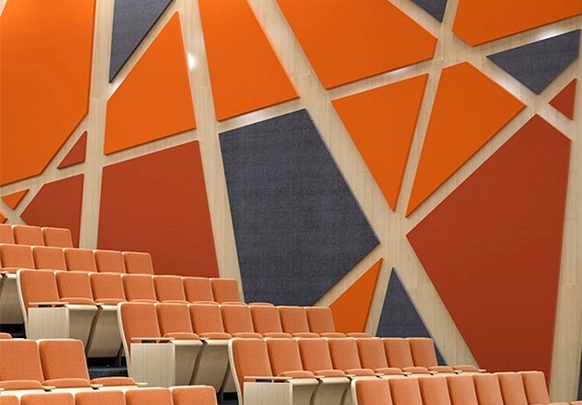
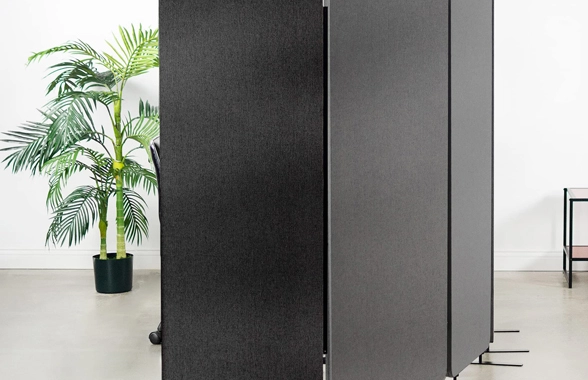
In 2026, the criteria by which B2B buyers evaluate acoustic products have expanded significantly beyond sound absorption performance, color range, and price. Carbon border adjustment mechanisms, ESG reporting obligations, green building certification requirements, and circular economy procurement policies have collectively elevated material sustainability from a secondary consideration to a primary procurement filter — one that can determine whether a product qualifies for a project before acoustic performance is even evaluated.
For interior acoustic projects in offices, schools, hotels, healthcare facilities, and public buildings, buyers are no longer asking only whether a panel reduces echo. They are asking whether the material contains recycled content, whether it is recyclable at end of life, whether the production process is energy-efficient, and whether the supplier can provide the documentation that ESG reporting and green building certification require. Acoustic panels made from 100% recyclable polyester fiber — produced from post-consumer recycled PET recovered from used plastic bottles — address all of these requirements simultaneously, making them the most commercially practical sustainable acoustic solution available in 2026.
For global buyers searching for reliable acoustic panels china suppliers who can combine genuine sustainability credentials with commercial acoustic performance and design flexibility, Polyacoustic offers eco-friendly sound absorption products that meet the acoustic, environmental, and documentation requirements of international commercial projects. This guide covers the complete picture: why green procurement pressure is reshaping acoustic panel sourcing in 2026, how recycled PET becomes high-performance acoustic panels through a traceable production process, what material and performance factors determine product quality, how recycled PET compares to traditional acoustic materials, and what procurement and maintenance practices protect both acoustic performance and ESG value over the product's service life. Secondary keywords relevant to this decision — recycled PET acoustic panels China, eco-friendly sound absorbers, sustainable acoustic felt manufacturer, and 100% polyester fiber panels — are addressed throughout.
The shift in acoustic panel procurement from purely performance-based evaluation to sustainability-inclusive decision-making is not driven by buyer preference alone. It is being driven by a convergence of regulatory, commercial, and institutional pressures that are becoming increasingly difficult to navigate without a clear sustainable materials strategy.
Carbon border adjustment and trade compliance is the most significant regulatory development affecting material procurement for international B2B buyers in 2026. The European Union's Carbon Border Adjustment Mechanism places a carbon price on imports of goods with high embedded carbon content, creating a direct financial incentive for buyers to source materials with documented lower carbon footprints. For buyers sourcing acoustic panels china production for European projects or distribution, the carbon intensity of the manufacturing process and the recycled content of the material are no longer abstract sustainability metrics — they are factors that affect the landed cost and market access of the product. Suppliers who cannot provide carbon footprint documentation or demonstrate meaningful recycled content are increasingly at a commercial disadvantage in regulated markets.
ESG reporting and corporate sustainability commitments create internal procurement pressure that mirrors the external regulatory pressure. Organizations that have committed to annual carbon reduction targets, circular economy procurement policies, or specific recycled content thresholds in their material purchasing need their acoustic panel suppliers to provide documented evidence of recycled PET content, recyclability, and production energy efficiency. Acoustic panels that cannot provide this documentation are excluded from consideration regardless of their acoustic performance — not because buyers do not value acoustic performance, but because they cannot afford the compliance and reputational risk of sourcing materials that undermine their sustainability commitments.
Green building certification requirements add a third layer of sustainability pressure by awarding credits for recycled content materials, low-VOC products, and materials with documented end-of-life recyclability. For projects pursuing LEED, BREEAM, WELL, or regional green building certification, acoustic panels made from recycled PET polyester fiber can contribute directly to certification credits in ways that traditional acoustic materials cannot — making the material specification decision a certification strategy decision as much as an acoustic performance decision.
Recycled PET acoustic panels China production addresses all three sustainability pressure points simultaneously. The use of post-consumer recycled PET reduces the carbon footprint of the material compared with virgin polyester production. The 100% polyester fiber composition makes the panels recyclable at end of life, supporting circular economy procurement policies. And the documented recycled content and recyclability credentials provide the evidence that ESG reporting and green building certification require. For global buyers who need eco-friendly sound absorbers that qualify as sustainable materials under multiple certification and reporting frameworks, recycled PET panels from a capable sustainable acoustic felt manufacturer represent the most practical available solution in 2026.
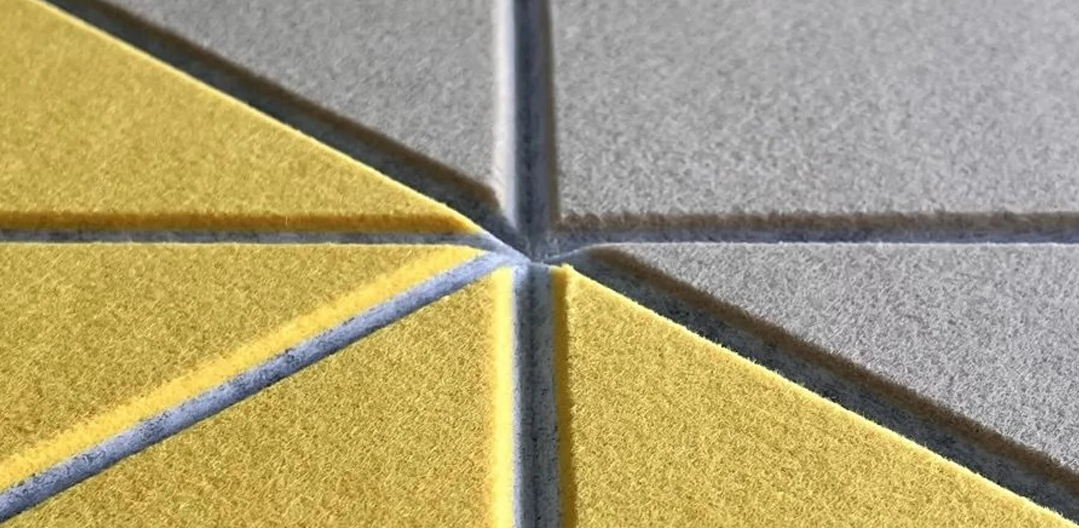
Understanding how post-consumer PET plastic is transformed into finished acoustic panels helps buyers evaluate the sustainability credentials of the production process, assess the quality implications of different manufacturing approaches, and communicate the circular economy story to their own stakeholders.
Collection and sorting is the foundation of the recycled PET supply chain. Used PET bottles are collected from post-consumer waste streams, sorted by material type, and separated from other plastics, metals, and organic contamination. Labels, caps, and adhesives are removed to prepare the material for recycling. The quality and consistency of this initial sorting process directly affects the quality of the recycled fiber produced downstream — contaminated or poorly sorted feedstock produces lower-quality fiber with inconsistent acoustic performance characteristics.
Cleaning and crushing converts the sorted bottles into uniform PET flakes through a washing and shredding process. The flakes are further cleaned, dried, and quality-checked before being fed into the fiber production process. The consistency of the flake quality at this stage is a key determinant of the fiber quality and, ultimately, the acoustic performance consistency of the finished panels — which is why buyers evaluating acoustic panels china suppliers should ask about feedstock quality control as well as finished product testing.
Fiber formation is the process by which PET flakes are melted and extruded through spinnerets to form continuous polyester filaments, which are then cut into staple fibers of the appropriate length and diameter for acoustic panel production. The fiber diameter, length, and crimp characteristics determine the packing density and pore structure of the finished panel — parameters that directly affect the panel's sound absorption coefficient across the frequency range. This is the stage where the technical expertise of the manufacturer most directly affects the acoustic performance of the finished product.
Thermal bonding converts loose polyester fibers into the dense, stable panel structure that gives acoustic panels their mechanical integrity and acoustic performance. The fibers are formed into a web, compressed to the target density, and bonded using heat and pressure — a process that fuses the fiber intersections without requiring chemical binders or adhesives. This binder-free thermal bonding process is both the key to the panel's acoustic performance and a significant factor in its sustainability credentials: the absence of chemical binders means that the finished panel is a single-material product that can be recycled without the material separation challenges that multi-material composite products present.
Cutting, coloring, and customization is the final production stage, where the bonded acoustic felt is processed into the sizes, shapes, colors, and configurations required for specific applications. CNC cutting technology allows precise cutting of complex shapes, patterns, perforations, and three-dimensional profiles. The availability of a wide color range — Polyacoustic offers extensive color options for its acoustic panel range — supports the design integration requirements of commercial interior projects where acoustic treatment must complement the visual design intent of the space.
The traceable, documented production process of recycled PET acoustic panels provides the supply chain transparency that ESG reporting and green procurement policies require. Buyers who need to document the recycled content of their material purchases, demonstrate circular economy procurement practices, or provide evidence for green building certification credits need suppliers who can provide this documentation reliably and consistently across large commercial orders — making supplier transparency and documentation capability as important as product performance in the sourcing evaluation.
The acoustic performance of a recycled PET panel is determined by the physical characteristics of its polyester fiber structure. Understanding these performance factors helps buyers specify acoustic panels that deliver the sound absorption performance their projects require — not just the sustainability credentials their procurement policies demand.
Acoustic panels work by converting sound energy into heat through viscous friction as sound waves propagate through the porous fiber structure of the panel. When a sound wave enters the panel, the oscillating air pressure causes the air in the panel's pore network to move relative to the fiber structure. The friction between the moving air and the fiber surfaces converts the kinetic energy of the sound wave into a small amount of thermal energy — reducing the amplitude of the reflected sound wave and shortening the reverberation time of the space.
The efficiency of this energy conversion depends on the relationship between the sound wavelength and the pore size of the fiber structure. Lower-frequency sounds have longer wavelengths and require thicker panels or higher-density fiber structures to achieve adequate absorption. Higher-frequency sounds are absorbed more efficiently by thinner panels. This frequency-dependent absorption behavior is why panel thickness is one of the most important specification parameters for acoustic panels — and why buyers should request absorption coefficient data across the full frequency range rather than relying on a single NRC value.
| Performance Factor | Why It Matters | Specification Guidance |
|---|---|---|
| Fiber density | Affects sound absorption coefficient and panel mechanical strength | Higher density improves mid and low-frequency absorption |
| Panel thickness | Determines absorption across different frequency ranges | Thicker panels improve low-frequency performance |
| Recycled PET content | Supports ESG reporting and green procurement credentials | Confirm percentage and request documentation |
| Surface finish | Affects appearance, design flexibility, and cleanability | Smooth, textured, or custom-printed options for different applications |
| Color consistency | Critical for large commercial projects with multiple panels | Confirm batch consistency and color matching capability |
| CNC cutting precision | Supports custom shapes, patterns, and perforations | Confirm cutting tolerance and minimum order for custom work |
| Fire safety rating | Required for commercial interior compliance | Confirm fire class for building type and destination market |
| Recyclability | Supports circular economy procurement and end-of-life planning | Confirm single-material composition and recycling pathway |
100% polyester fiber panels offer a combination of acoustic performance and practical handling characteristics that make them well-suited to the demanding requirements of commercial interior projects. They are lightweight — significantly lighter than mineral wool or fiberglass panels of equivalent thickness — which simplifies installation and reduces structural loading on wall and ceiling mounting systems. They can be cut, shaped, and perforated with standard CNC equipment without generating the airborne fiber irritants associated with some traditional acoustic materials. Their single-material composition simplifies end-of-life recycling. And their availability in a wide range of colors supports the design integration requirements of commercial interior projects where acoustic treatment must complement rather than compromise the visual design intent.
The decision to specify recycled PET acoustic panels over traditional acoustic materials involves evaluating both acoustic performance and sustainability credentials — and understanding where each material type excels and where it has limitations for specific project requirements.
Recycled PET acoustic panels are the strongest choice for commercial interior applications where the combination of acoustic performance, design flexibility, sustainability credentials, and installation practicality are all important. Their recyclable single-material composition, documented recycled content, lightweight handling, and extensive customization options make them the most versatile option for the broad range of commercial acoustic applications that 2026 buyers encounter. Their primary limitation is that very thick panels may be required for strong low-frequency absorption in applications where bass frequency control is critical.
Fabric-wrapped fiberglass panels provide strong acoustic performance across a wide frequency range and are a well-established choice for studios, meeting rooms, and theaters where acoustic performance is the primary criterion. Their sustainability credentials are more limited — fiberglass is not recyclable in the same way as polyester fiber, and the fabric covering adds a second material that complicates end-of-life disposal. They also require more careful handling during installation due to fiber irritation risk.
Acoustic foam panels are a low-cost option for light-duty sound treatment where budget is the primary constraint. Their durability, fire safety performance, and sustainability credentials are generally inferior to recycled PET panels, and they are not suitable for most commercial interior applications where long-term performance and compliance are required.
Wood acoustic panels provide a premium aesthetic option for high-end commercial interiors where the visual quality of the acoustic treatment is as important as its acoustic performance. They are significantly heavier and more expensive than PET panels, and their sustainability credentials depend on the wood sourcing and certification of the specific product.
Mineral wool panels provide strong absorption performance and are widely used in industrial and building acoustic applications. They require protective covering for most interior applications due to fiber irritation concerns, and their sustainability profile is more complex than recycled PET.
| Material Type | Best Application | Sustainability Credentials | Key Limitation |
|---|---|---|---|
| Recycled PET acoustic panels | Offices, schools, hotels, studios, public spaces | Recyclable, recycled content, single-material, binder-free | May need greater thickness for low-frequency control |
| Fabric-wrapped fiberglass | Studios, meeting rooms, theaters | Limited recyclability, multi-material | Fiber irritation risk during installation |
| Acoustic foam | Light-duty treatment, budget applications | Variable | Durability and fire safety limitations |
| Wood acoustic panels | Premium interiors, auditoriums, hospitality | Depends on wood certification | Heavy, expensive, limited customization |
| Mineral wool panels | Industrial and building acoustic systems | Moderate | Requires protective covering for interior use |
The combination of acoustic performance, design flexibility, and sustainability credentials makes recycled PET acoustic panels the preferred choice across a wide range of commercial applications: open-plan offices where acoustic comfort and ESG procurement credentials are both required, educational institutions pursuing green building certification for new construction and renovation projects, hospitality venues where acoustic comfort and interior design quality are both commercial priorities, healthcare facilities where indoor air quality and material safety are critical alongside acoustic performance, recording studios and podcast production spaces where acoustic performance and design aesthetics are both important, public buildings and transportation hubs where large-scale acoustic treatment must meet both performance and sustainability standards, and retail and commercial showroom environments where acoustic panels serve both functional and brand communication purposes.
Sourcing recycled PET acoustic panels from a China-based sustainable acoustic felt manufacturer for international commercial projects requires systematic evaluation of both product quality and supplier capability — and ongoing maintenance practices that protect acoustic performance and appearance over the product's service life.
Before selecting a supplier for recycled PET acoustic panels, buyers should confirm the following:
Verify the actual recycled PET content of the panels — confirm the percentage of post-consumer recycled material and request documentation that supports ESG reporting and green building certification claims
Confirm the material composition — 100% polyester fiber panels with no chemical binders are the most straightforward to recycle and the most suitable for circular economy procurement policies
Request acoustic performance data — absorption coefficient values across the full frequency range — and confirm that the data is from accredited third-party testing
Confirm available panel thicknesses and their corresponding acoustic performance profiles — ensure that the specified thickness is appropriate for the frequency range of the primary noise problem
Verify fire safety rating and confirm compliance with the building code and certification requirements of the destination market
Confirm VOC emission levels and indoor air quality compliance for the specific application — healthcare, educational, and WELL-certified projects typically have strict VOC requirements
Assess color consistency capability for large commercial orders — request color samples and confirm batch-to-batch consistency standards
Confirm CNC cutting capability for custom shapes, patterns, and perforations — and request samples of custom-cut work before committing to a large order
Evaluate the supplier's export experience and packaging capability for international shipping
Confirm production capacity and lead time for the project volume
Request samples before placing a bulk order — acoustic performance, color accuracy, surface finish quality, and dimensional consistency should all be verified on physical samples before procurement commitment
Confirm whether the product can support ESG reporting, green building certification, or annual sustainability targets — and request the specific documentation that your reporting framework requires
Dust panel surfaces regularly using a soft brush or vacuum with a brush attachment — dust accumulation on the panel surface reduces absorption performance over time by partially blocking the pore structure
Avoid saturating panels with water or liquid cleaning agents — PET polyester fiber panels are not designed for wet cleaning and may be damaged by moisture absorption
Clean light surface stains using a slightly damp cloth with gentle pressure — avoid scrubbing, which can damage the surface fiber structure
Keep panels away from sharp objects, heavy impact, and abrasive contact that could damage the surface finish or structural integrity
Inspect wall and ceiling fixing systems at regular intervals, particularly in high-humidity environments where adhesive performance may degrade over time
Replace individual damaged or heavily stained panels rather than removing the entire installation — the modular nature of acoustic panel systems allows individual panels to be replaced without disrupting the surrounding installation
Store spare panels in a clean, dry, flat storage area — avoid stacking heavy objects on top of stored panels, which can cause permanent compression of the fiber structure
Keep color codes, batch records, and supplier information for future panel matching — color consistency between different production batches can vary, and having accurate records simplifies future replacement or expansion orders
Reassess the acoustic layout if the room function, occupancy density, or furniture configuration changes significantly
In 2026, the acoustic panel procurement decision has become a sustainability decision as much as a performance decision. Carbon border adjustment mechanisms, ESG reporting requirements, green building certification standards, and circular economy procurement policies have collectively elevated recycled content, recyclability, and production transparency from marketing claims to procurement prerequisites for B2B buyers in regulated markets.
Recycled PET acoustic panels — transforming post-consumer plastic bottles into high-performance 100% polyester fiber panels through a traceable, documented manufacturing process — address all of these requirements simultaneously. The acoustic performance is comparable to traditional materials across the frequency ranges relevant to commercial interior applications. The sustainability credentials are genuine and documentable. The design flexibility — extensive color options, CNC custom cutting, multiple thickness options, and compatibility with wall, ceiling, partition, and furniture applications — supports the full range of commercial interior design requirements. And the single-material recyclable composition provides the end-of-life circular economy value that forward-looking procurement policies require.
For global buyers looking for dependable acoustic panels china solutions that combine genuine sustainability credentials with commercial acoustic performance, Polyacoustic provides a practical pathway toward eco-friendly sound absorption, flexible customization, and sustainable interior design — with production capability, export experience, and product documentation that support international commercial projects across offices, schools, hotels, studios, healthcare facilities, and public buildings.
Contact Polyacoustic today to discuss your project requirements, acoustic performance targets, recycled PET material specifications, custom color and shape options, fire rating requirements, and bulk order plans. The Polyacoustic team can help you specify the right acoustic panels for your sustainable commercial interior project — and provide the material documentation and ESG support that your procurement and reporting requirements demand.
Q1: What are recycled PET acoustic panels and how are they different from standard acoustic panels?
Recycled PET acoustic panels are sound-absorbing panels made from 100% polyester fiber produced using post-consumer recycled PET — primarily recovered from used plastic bottles. Unlike standard acoustic panels that may use virgin polyester, fiberglass, mineral wool, or foam, recycled PET panels are produced from documented post-consumer recycled content, are recyclable at end of life as a single-material product, and are manufactured without chemical binders — making them the most suitable acoustic material for projects with ESG reporting requirements, green building certification goals, or circular economy procurement policies. Their acoustic performance is comparable to traditional materials across the mid and high-frequency ranges relevant to most commercial interior applications.
Q2: Are 100% polyester fiber panels genuinely recyclable and how does this support ESG goals?
Yes. 100% polyester fiber panels produced without chemical binders are a single-material product that can be recycled through polyester fiber recycling streams at end of life. This single-material recyclability is a significant advantage over multi-material acoustic products — such as fabric-wrapped fiberglass panels — where the different material layers must be separated before recycling, which is often impractical in commercial waste streams. For buyers with ESG reporting obligations, the documented recycled content of the input material and the recyclability of the finished product provide the evidence needed to support circular economy procurement reporting, green building certification credits, and annual sustainability target documentation.
Q3: How do recycled PET acoustic panels perform compared with fiberglass or mineral wool panels for commercial applications?
Recycled PET acoustic panels provide sound absorption performance that is comparable to fiberglass and mineral wool panels across the mid and high-frequency ranges relevant to most commercial interior acoustic applications — speech intelligibility improvement, reverberation time reduction, and general noise comfort in offices, schools, and hospitality spaces. For applications requiring strong low-frequency absorption — recording studios or spaces with significant mechanical noise — thicker PET panels or supplementary low-frequency treatment may be required. The practical handling advantages of PET panels — lightweight, no fiber irritation risk, easy CNC cutting, and wide color availability — make them the preferred choice for most commercial interior projects where acoustic performance, design flexibility, and sustainability credentials are all important.
Q4: What should international buyers check when sourcing acoustic panels china from a sustainable acoustic felt manufacturer?
International buyers should verify the actual recycled PET content and request documentation that supports ESG reporting and green building certification claims, confirm acoustic performance data from accredited third-party testing across the full frequency range, check fire safety rating compliance for the destination market, assess color consistency capability for large commercial orders, confirm CNC cutting capability for custom shapes and patterns, evaluate export packaging quality for long-distance shipping, confirm production capacity and lead time for the project volume, and request physical samples before placing a bulk order to verify acoustic performance, color accuracy, and surface finish quality. Supplier transparency about production processes, material sourcing, and quality control is as important as product performance in the evaluation of a sustainable acoustic felt manufacturer.
Q5: Can recycled PET acoustic panels support green building certification and annual ESG carbon reduction targets?
Yes. Recycled PET acoustic panels can contribute to green building certification credits under LEED, BREEAM, WELL, and other certification systems through their documented post-consumer recycled content, recyclable single-material composition, low-VOC production process, and indoor air quality compatibility. For annual ESG carbon reduction targets, the use of recycled PET content reduces the embedded carbon of the material compared with virgin polyester production, and the recyclability of the finished panel supports end-of-life carbon accounting. Buyers should confirm with their certification consultant which specific credits the acoustic panel specification can support, and request the appropriate environmental product documentation from the supplier before finalizing the specification.