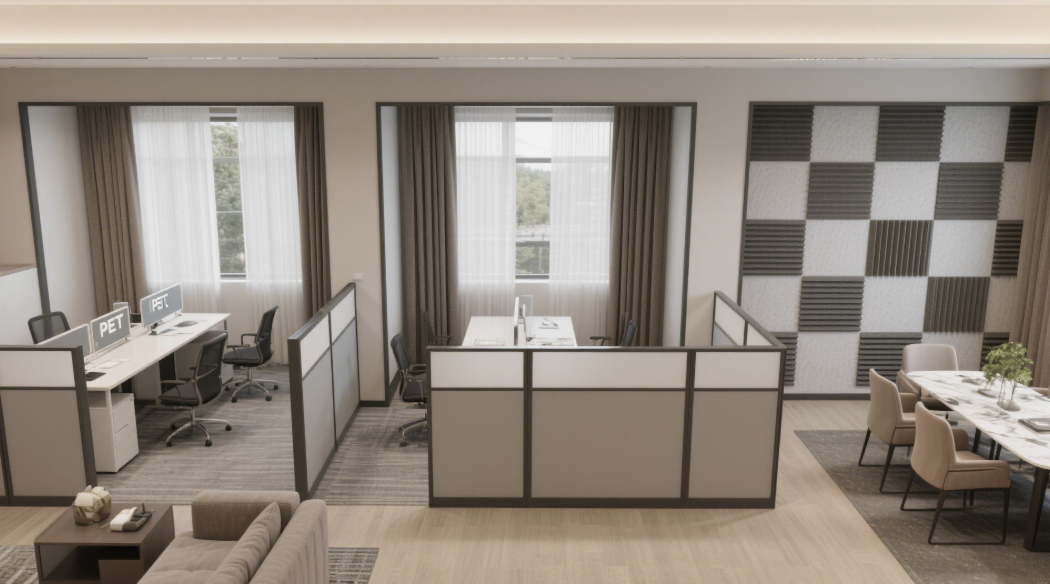
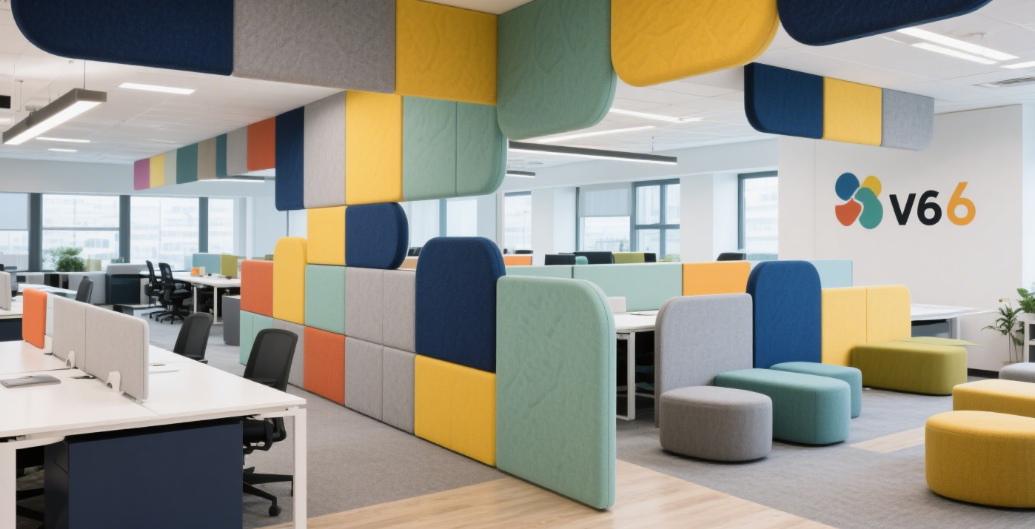
As commercial buildings become more open, collaborative, and architecturally ambitious, managing indoor acoustics has become a growing challenge for designers and project teams.
Large open spaces often create excessive reverberation, speech interference, and background noise. While these issues may not be immediately visible, they can significantly affect occupant comfort, communication, productivity, and overall user experience.
To address these challenges, architects commonly specify acoustic ceiling treatments. Among the most popular solutions are acoustic ceiling panels and acoustic ceiling baffles.
Although both products are designed to improve acoustic performance, they are often used in very different environments and support different design objectives.
For project teams evaluating acoustic solutions, understanding the differences between these systems is essential for achieving the right balance between performance, aesthetics, installation requirements, and budget.
Modern architecture increasingly favors large, open environments.
Open-plan offices, educational facilities, airports, exhibition halls, restaurants, and public buildings often feature exposed ceilings, hard flooring surfaces, and extensive glazing.
While these design elements create visually attractive spaces, they also increase sound reflection.
When sound repeatedly bounces between hard surfaces, reverberation builds up. Conversations become harder to understand, background noise increases, and occupants may experience fatigue or reduced concentration.
Wall treatments alone are often insufficient to solve these issues.
Because ceilings typically represent the largest uninterrupted surface area within a room, they offer one of the most effective opportunities for acoustic improvement.
This is why ceiling-based acoustic systems have become a critical component of modern commercial design.
Acoustic ceiling panels are flat sound-absorbing panels installed horizontally across ceiling structures.
They are commonly integrated into suspended ceiling systems or mounted directly beneath structural ceilings.
Because they provide continuous acoustic coverage, ceiling panels are particularly effective at controlling reverberation across large surface areas.
Many architects prefer acoustic ceiling panels when the goal is to create a clean, uniform ceiling appearance while improving sound absorption.
The panels can be manufactured using materials such as PET polyester fiber, mineral fiber, fiberglass, or other acoustic substrates.
In commercial projects, PET acoustic ceiling panels have become increasingly popular because they combine strong acoustic performance with lightweight construction, sustainability benefits, and design flexibility.
Unlike ceiling panels, acoustic ceiling baffles are vertically suspended elements that hang from the ceiling structure.
Rather than covering the ceiling surface, baffles create a series of acoustic fins that absorb sound from multiple directions.
This design provides several advantages.
Because both sides of the baffle remain exposed, the total sound-absorbing surface area is significantly increased. This makes baffles particularly effective in spaces with high ceilings and large open volumes.
Architects also appreciate their visual impact.
Acoustic baffles often become part of the architectural identity of a space, introducing rhythm, texture, and movement while maintaining an open ceiling aesthetic.
As exposed ceiling designs continue to gain popularity, acoustic baffles are increasingly specified in contemporary commercial projects.
Ceiling panels are often selected when project teams prioritize visual simplicity and broad acoustic coverage.
Educational facilities, corporate offices, healthcare environments, and conference rooms frequently benefit from panel-based systems because they create a clean and organized appearance while effectively reducing reverberation.
In spaces where mechanical systems, lighting, and other building services are concealed above the ceiling, acoustic panels integrate naturally into the architectural design.
They are also commonly used when project owners prefer a more traditional finished ceiling appearance.
For projects requiring high acoustic performance without drawing attention to the ceiling itself, panels often provide the most practical solution.
Baffles are often the preferred option for projects featuring exposed ceilings or large open spaces.
Airports, sports facilities, cafeterias, atriums, exhibition centers, and creative workplaces frequently use acoustic baffles because they preserve ceiling height while improving sound control.
In these environments, covering the entire ceiling may not be desirable from either an architectural or operational perspective.
Baffles allow designers to maintain access to exposed building services while introducing significant acoustic absorption.
They also provide greater opportunities for creative design.
Many modern projects use custom-shaped baffles, colored acoustic fins, or suspended acoustic features to create distinctive interior environments.
For spaces where aesthetics and acoustic performance are equally important, ceiling baffles often offer greater design flexibility.
Both systems can achieve excellent acoustic performance when properly specified.
The decision is usually less about which solution absorbs more sound and more about how the space is designed.
Comparison Factor | Acoustic Ceiling Panels | Acoustic Ceiling Baffles |
Acoustic Performance | Excellent | Excellent |
Open Ceiling Compatibility | Limited | Excellent |
Architectural Impact | Moderate | High |
Design Flexibility | Good | Excellent |
Installation Simplicity | Excellent | Good |
Visual Openness | Moderate | Excellent |
Suitable for High Ceilings | Good | Excellent |
In many projects, designers even combine both systems to optimize performance while achieving specific architectural goals.
Sustainability has become a major consideration in material selection.
Architects and developers are increasingly seeking acoustic products that contribute to environmental objectives while maintaining high performance standards.
PET acoustic ceiling panels and PET acoustic baffles are gaining popularity because they are often manufactured using recycled polyester fibers and can support green building initiatives.
In addition to their environmental benefits, these products offer durability, low maintenance requirements, and design versatility.
As sustainability continues to influence construction decisions, demand for environmentally responsible acoustic ceiling solutions is expected to increase.
There is no universal answer to whether ceiling panels or ceiling baffles are better.
The right solution depends on several project-specific factors, including ceiling height, architectural style, acoustic objectives, building services coordination, and budget requirements.
Projects with traditional ceiling systems often benefit from acoustic panels. Open-ceiling environments and architecturally expressive spaces frequently gain greater value from acoustic baffles.
The most successful projects evaluate acoustic requirements early in the design process rather than treating acoustics as a secondary consideration.
By integrating acoustic planning into the overall design strategy, project teams can achieve better long-term outcomes while avoiding costly post-occupancy modifications.
As commercial buildings continue to evolve, acoustic comfort is becoming a key factor in occupant satisfaction and building performance.
Both acoustic ceiling panels and acoustic ceiling baffles provide effective solutions for controlling noise and improving speech clarity. However, they serve different architectural and functional objectives.
Ceiling panels are often ideal for projects requiring clean, consistent ceiling aesthetics, while ceiling baffles excel in open environments where design flexibility and visual impact are priorities.
For architects, contractors, and building owners, understanding these differences is essential when selecting the most appropriate acoustic solution.
By choosing the right system at the design stage, project teams can create spaces that are not only visually impressive but also acoustically comfortable and operationally successful.