In 2026, the way companies occupy and configure office space has changed fundamentally. Hybrid work schedules, project-based team structures, frequent headcount fluctuations, and the growing likelihood of office relocation within a three-to-five year horizon have made fixed renovation a commercially questionable strategy for most organizations. When a company invests in drywall partitions, permanent acoustic wall treatments, and built-in soundproofing infrastructure, it is making a long-term bet on a specific floor plan, a specific team size, and a specific way of working — a bet that an increasing number of organizations are no longer willing to make.
The smarter alternative is to treat acoustic improvement as a movable asset rather than a fixed installation. Soundproofing office cubicles — modular acoustic workstation systems, freestanding partitions, acoustic phone booths, seating booths, and desk screens — provide the privacy, noise reduction, and focus support that modern knowledge workers need, without anchoring the investment to a single floor plan. When the team grows, the cubicles scale. When the layout changes, the panels reconfigure. When the company moves, the acoustic assets move with it. Soundproof office furniture turns what was previously a sunk cost into a reusable, long-life workplace investment that retains its value across multiple office configurations and locations.
For companies planning office upgrades, hybrid workspace redesigns, or open-plan acoustic improvements, Acousound's acoustic office products include desk partitions, phone booths, seating booths, and acoustic office screens designed to reduce noise, improve privacy, and support workplace productivity — with customization options for color, size, shape, and mounting configuration that allow the system to integrate with any office design. This guide covers the complete picture for workplace decision-makers and procurement teams: why fixed renovation is losing its commercial case in 2026, how modular soundproofing office cubicles work as acoustic assets, what components determine performance and reusability, how the total cost of ownership compares to traditional partition walls over a five-to-ten year period, and what procurement and maintenance practices protect the long-term value of the investment. Secondary keywords relevant to this decision — modular office cubicles, movable soundproof partitions, flexible workspace acoustics, and cost-effective office soundproofing — are addressed throughout.
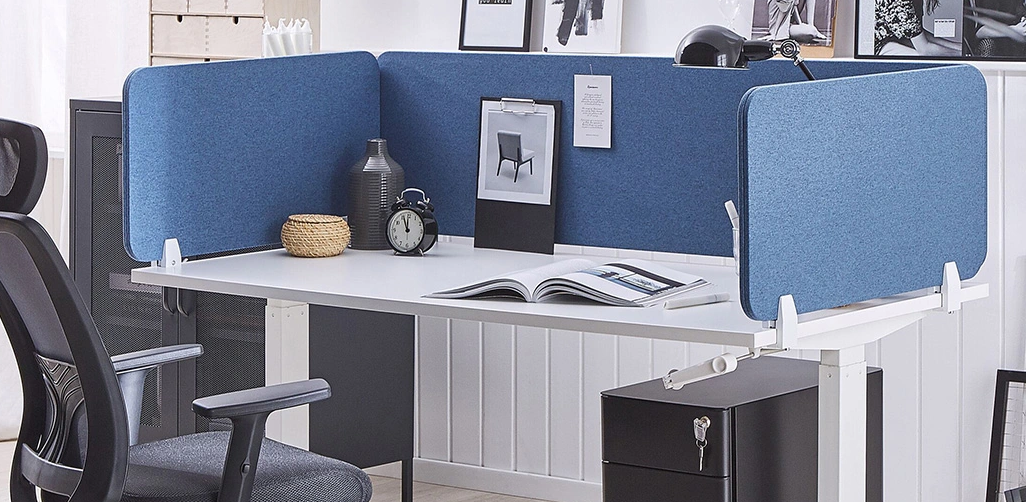
The commercial case against fixed acoustic renovation in 2026 is not primarily about the upfront cost — although that is significant. It is about the structural mismatch between the permanence of fixed construction and the pace of change in modern workplace requirements.
Traditional acoustic renovation — drywall partitions, built-in soundproofing, permanent room construction — was designed for a workplace model that assumed relative stability: stable team sizes, stable floor plans, stable ways of working, and long lease terms that justified significant fit-out investment. That model has been disrupted by hybrid work, agile team structures, and the increasing frequency with which companies resize, restructure, and relocate their office operations.
When a company installs fixed drywall partitions to create acoustic separation between teams, it commits to a specific spatial configuration that may become obsolete within two to three years. If the team that the partition was built to serve grows, shrinks, or reorganizes, the partition either constrains the new configuration or must be demolished — at additional cost, with additional disruption, and with zero reuse value from the original investment. The acoustic performance of the fixed partition is permanently embedded in the building fabric, not in a portable asset that the company owns and controls.
The hidden costs of fixed renovation compound this problem. Construction requires permits or building coordination in many commercial tenancies. Installation creates dust, noise, and operational disruption that affects productivity during the build period. HVAC, lighting, sprinkler, and cable systems may need to be modified to accommodate new partitions. And when the company eventually relocates — as a growing proportion of organizations do within a five-to-seven year horizon — the entire fixed investment is left behind.
Soundproofing office cubicles reframe the acoustic investment decision entirely. Instead of spending capital on fixed construction that depreciates to zero at the end of the lease, companies invest in modular soundproof office furniture that retains its functional value across multiple office configurations and locations. The acoustic panels, desk screens, freestanding partitions, and phone booths that make up a modular cubicle system can be disassembled, transported, and reinstalled in a new location — converting what would have been a sunk cost into a portable asset that moves with the business.
Acousound highlights modular furniture systems as flexible and customizable solutions for shared offices, allowing workspaces to be reconfigured with acoustic screens, desk dividers, and other modular elements as team structures and space requirements change. This reconfigurability is the commercial foundation of the modular acoustic asset argument: the same investment that solves today's acoustic problem can be reconfigured to solve tomorrow's different acoustic problem, without additional capital expenditure.
Understanding the full range of products that fall under the soundproofing office cubicles category — and what each type is best suited for — helps procurement teams specify the right combination of acoustic furniture for their specific workplace requirements.
Soundproofing office cubicles is a broad category that encompasses several distinct product types, each addressing a different aspect of the open office acoustic and privacy problem:
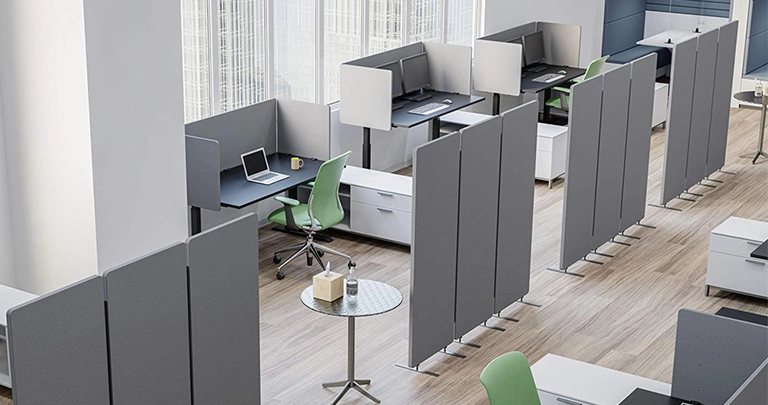
Modular office cubicles are the core product — configurable workstation enclosures made from acoustic panels that create semi-private work zones within open-plan offices. They provide both acoustic absorption and physical separation between workstations, reducing near-field speech noise and visual distraction simultaneously. Their modular construction allows them to be assembled in different configurations — single workstations, team clusters, or row arrangements — and reconfigured as team layouts change.
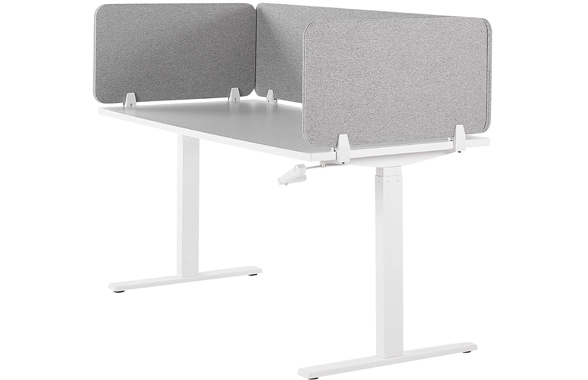
Acoustic desk partitions are desk-mounted or desk-adjacent panels that create a personal acoustic and visual boundary at the individual workstation level. They are the most targeted form of soundproof office furniture — addressing the near-field distraction problem for individual employees without requiring changes to the broader office layout.
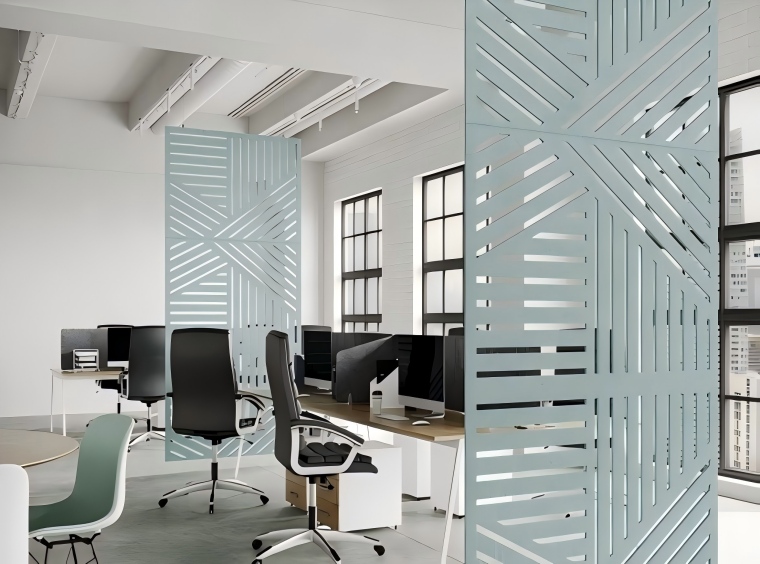
Freestanding acoustic screens are floor-standing panels that can be positioned anywhere in the office to create temporary or semi-permanent zone divisions. They are particularly valuable for creating project team areas, separating collaboration zones from focus zones, or providing acoustic separation in areas where desk-mounted solutions are not practical.
Acoustic phone booths are fully or partially enclosed freestanding structures that provide a private space for phone calls, video meetings, and confidential conversations. They are the highest-privacy option in the modular acoustic furniture range and are particularly valuable for sales teams, HR functions, management, and hybrid meeting participants who need a quiet, private space within the open office.
Seating booths provide semi-enclosed spaces for focused individual work and small informal meetings. They combine acoustic absorption with comfortable seating to create breakout zones that support both concentration and collaboration without requiring dedicated enclosed rooms.
Movable soundproof partitions are larger freestanding acoustic panels that can divide open office areas into distinct zones. They are particularly useful for coworking spaces, training rooms, and agile offices where the spatial configuration needs to change frequently.
Acousound's acoustic office partition range includes PET acoustic desk screens, fabric-wrapped desk screens, U-shape acoustic desk screens, freestanding acoustic screens, fabric-wrapped acoustic partitions, acoustic whiteboards, and suspended acoustic space dividers — providing a comprehensive product ecosystem that covers every layer of the modular acoustic furniture requirement.
| Product Type | Primary Function | Best Application |
|---|---|---|
| Modular office cubicles | Create flexible semi-private workstation zones | Open-plan offices, hybrid teams, hot-desk environments |
| Acoustic desk partitions | Reduce near-field speech distraction at individual desks | Individual workstations, shared benching systems |
| Freestanding acoustic screens | Divide zones without construction | Project teams, temporary layouts, flexible offices |
| Acoustic phone booths | Create private calling and video meeting spaces | Sales teams, HR, management, hybrid meetings |
| Seating booths | Support focused work and small informal meetings | Breakout areas, collaboration zones |
| Movable soundproof partitions | Reconfigure office space quickly and flexibly | Coworking spaces, training rooms, agile offices |
Modular soundproof office furniture does not simply block sound — it improves the acoustic environment through a combination of sound absorption, partial sound shielding, visual privacy creation, and spatial zoning that together reduce the distraction and privacy problems that open offices create.
Sound absorption is the primary acoustic mechanism of modular office cubicles. The acoustic materials used in the panels — PET polyester fiber, compressed wool felt, fabric-wrapped acoustic core, or open-cell foam — absorb a portion of the sound energy from nearby speech, phone calls, keyboard activity, and general office noise. This absorption reduces the ambient noise level in the immediate vicinity of the cubicle and shortens the reverberation time in the local acoustic environment, making speech less intelligible at a distance and reducing the cognitive disruption caused by nearby conversations.
Acousound's PET-based acoustic office products can achieve NRC ratings up to 0.85 — meaning that up to 85% of the sound energy that strikes the panel surface is absorbed rather than reflected. This level of absorption performance is sufficient to create a meaningful reduction in near-field noise levels and to contribute to improved whole-room acoustic comfort when multiple panels are deployed across the office.
Physical separation through cubicle panels, booth walls, and movable partitions creates a partial barrier between work zones that reduces the direct sound transmission path between nearby employees. While modular acoustic furniture does not provide the complete sound isolation of a fully enclosed room, the combination of absorption and physical separation is sufficient to meaningfully reduce the intelligibility of nearby speech — which is the primary cognitive disruptor for knowledge workers in open offices.
Visual privacy through panel height and configuration reduces the visual distraction from movement, activity, and the general awareness of being observed that contributes to the fragmented concentration patterns of open office workers. When employees cannot see the movement and activity of colleagues in their peripheral visual field, they experience fewer involuntary attention shifts and can maintain sustained concentration for longer periods.
Reconfigurable spatial zoning is the feature that distinguishes modular office cubicles from fixed acoustic solutions. Unlike drywall partitions that permanently define the spatial organization of the office, modular systems can be rearranged to create different zone configurations as team structures, project requirements, and occupancy patterns change. This reconfigurability is what makes flexible workspace acoustics achievable without construction — and what makes the modular acoustic furniture investment retain its value across multiple office configurations.
| Performance Factor | Why It Matters | Specification Guidance |
|---|---|---|
| Acoustic material | Determines NRC rating and absorption performance | PET polyester, compressed wool, acoustic foam, or fabric-wrapped panels |
| Panel height | Affects privacy level and sound separation | Higher panels improve separation but may affect openness and light |
| Panel thickness | Influences absorption performance and durability | Thicker panels improve low-frequency absorption |
| Mounting hardware | Determines mobility, stability, and reconfiguration ease | Desk clamps, T-feet, sliding brackets, or floor mounts |
| Surface finish | Affects aesthetics, brand integration, and cleanability | Fabric, PET felt, printed graphics, or custom colors |
| Fire and safety rating | Required for commercial office compliance | Confirm fire class for building and jurisdiction requirements |
| Reusability and repairability | Drives long-term ROI | Prioritize durable, modular, and individually replaceable panel systems |
The most commercially compelling argument for soundproofing office cubicles over traditional fixed renovation is the total cost of ownership comparison over a five-to-ten year period — the timeframe over which most commercial office leases and workplace investments are evaluated.
The upfront cost of drywall partition construction is only the beginning of the total cost calculation for fixed acoustic renovation. A complete accounting of the five-to-ten year cost of traditional partition walls must include:
Design and construction costs — architectural drawings, contractor fees, materials, and labor for the initial installation. Building coordination and permit costs — in many commercial tenancies, structural modifications require landlord approval and may require building permits. Operational disruption costs — construction creates dust, noise, and access restrictions that reduce productivity during the installation period, which may extend over days or weeks for a significant partition project. System modification costs — HVAC, lighting, sprinkler, and cable systems may need to be modified to accommodate new partitions, adding cost and complexity beyond the partition construction itself. Demolition costs at relocation — when the company moves or redesigns the space, fixed partitions must be demolished at additional cost, with zero reuse value from the original investment. Opportunity cost of inflexibility — a fixed partition that constrains the office layout as team structures change may force suboptimal space utilization that has its own productivity and real estate cost implications.
The five-to-ten year cost of modular soundproof office furniture is structured very differently:
Product purchase cost — the upfront investment in acoustic panels, desk screens, booths, and freestanding partitions. Delivery and installation cost — typically significantly lower than construction, with installation measured in hours rather than days and requiring no specialist contractors. Reconfiguration labor — the periodic cost of rearranging panels as team layouts change, which is minimal compared with construction costs. Replacement parts — individual damaged panels can be replaced without replacing the entire system, extending the useful life of the investment. Reuse value at relocation — the entire modular system can be disassembled, transported, and reinstalled at the new location, converting what would have been a sunk cost into a portable asset that retains its full functional value.
The cost-effective office soundproofing argument for modular acoustic furniture is most compelling for fast-growing technology companies that expect significant headcount changes within a three-to-five year horizon, professional services firms that restructure teams frequently around client projects, financial services organizations that need to create compliant private conversation spaces without permanent construction, co-working space operators who need to reconfigure their layouts for different tenant requirements, educational institutions that need flexible acoustic zoning for different teaching and administrative functions, and any organization that is approaching a lease renewal decision and wants to avoid committing capital to fixed renovation in a space they may not occupy long-term.
| Option | Best Application | 5–10 Year TCO Advantage | Key Limitation |
|---|---|---|---|
| Soundproofing office cubicles | Flexible offices, hybrid teams, growing companies | Reusable, scalable, lower disruption, portable at relocation | Requires thoughtful layout planning |
| Movable soundproof partitions | Temporary zones, training spaces, agile offices | Easy relocation, flexible workspace acoustics | May not replace fully enclosed rooms for high-isolation needs |
| Acoustic phone booths | Private calls, video meetings, confidential conversations | Strong privacy value, fully portable asset | Higher unit cost than panel systems |
| Traditional drywall partitions | Permanent rooms, high-isolation requirements | Strong separation when properly built | Hard to move, demolition cost, zero reuse value |
| Glass partitions | Premium design, natural light preservation | Modern appearance | Often requires additional acoustic treatment |
Specifying and procuring soundproofing office cubicles that deliver the acoustic performance, flexibility, and long-term value that the investment case requires involves systematic planning before purchase and consistent maintenance practices throughout the product's service life.
Before purchasing soundproofing office cubicles, workplace teams and procurement managers should confirm the following:
Define the primary acoustic and privacy problem: near-field speech noise, meeting spillover, phone call privacy, visual distraction, or zone separation — different problems favor different product combinations
Count the number of employees and workstations that need acoustic treatment, and identify the highest-priority zones for initial deployment
Assess the office layout: fixed desks, hot-desks, hybrid benching, project team areas, or mixed configurations — mounting method and panel type must match the desk and floor configuration
Determine whether the solution needs to include desk screens, freestanding screens, phone booths, seating booths, or a combination — and confirm the relative priority of each
Confirm whether the system needs to be fully portable for an anticipated office relocation within the planning horizon — prioritize freestanding and clamp-mounted systems over fixed-floor solutions if relocation is likely
Establish the required acoustic performance level — NRC rating, panel height, and thickness — based on the noise level and privacy requirement of the application
Confirm fire rating, VOC emission, and indoor air quality requirements for the specific building and jurisdiction
Determine customization requirements: colors, patterns, logos, or shapes that need to match the office interior design or brand identity — Acousound offers more than 60 PET felt colors and CNC cutting for custom shapes and logos
Verify that the selected system is compatible with existing desk hardware, monitor arms, cable management systems, and power modules
Calculate the five-to-ten year total cost of ownership for the modular acoustic furniture option against the equivalent fixed renovation option — including construction, disruption, demolition, and reuse value — to confirm the financial case
Confirm that the supplier can support large project orders, custom dimensions, and phased delivery for staged rollouts
Vacuum or dust acoustic panel surfaces regularly using a soft brush or vacuum with a brush attachment — dust accumulation reduces absorption performance and affects appearance over time
Avoid saturating PET or fabric-wrapped panels with water or liquid cleaning agents — most acoustic materials are not designed for wet cleaning and may be damaged by moisture
Clean fabric surfaces and stains according to the supplier's specific guidance — spot cleaning with a damp cloth is typically appropriate for minor marks
Inspect brackets, T-feet, desk clamps, floor mounts, and connection hardware at regular intervals — particularly after reconfiguration events that may have stressed the mounting components
Tighten loose hardware after every reconfiguration to maintain panel stability and alignment
Replace individual damaged or heavily stained panels rather than replacing the entire system — the modular design of acoustic office cubicles allows individual components to be replaced without disrupting the rest of the installation
Keep spare mounting accessories, connection hardware, and replacement panels available for the most heavily used workstation zones
Store unused panels vertically in a dry, clean space — horizontal stacking can cause warping in some acoustic panel materials over time
Reassess the acoustic layout after significant headcount changes, department restructuring, or office reconfiguration — a layout that was adequate for the original configuration may need adjustment as the office evolves
Maintain product drawings, order records, color codes, and supplier information for future expansion, replacement matching, and warranty claims
In 2026, the most commercially intelligent approach to office acoustic improvement is to stop treating it as a fixed renovation expense and start treating it as a movable, reusable, long-life workplace asset. Soundproofing office cubicles — modular acoustic workstation systems, freestanding partitions, acoustic phone booths, and desk screens — provide the privacy, noise reduction, and focus support that modern knowledge workers need, while retaining their full functional value across multiple office configurations, team restructurings, and physical relocations.
The five-to-ten year total cost of ownership comparison between modular soundproof office furniture and traditional fixed partition construction consistently favors the modular approach for organizations that expect any degree of change in their team size, layout, or location over the planning horizon. The acoustic performance is comparable. The flexibility is incomparably better. And the reuse value at relocation converts what would have been a sunk cost into a portable asset that continues to deliver productivity and privacy benefits wherever the business operates next.
Acousound provides acoustic office partitions, desk dividers, room dividers, phone booths, seating booths, acoustic screens, and bespoke project solutions for modern offices, co-working spaces, home offices, schools, and commercial environments — with products designed for noise reduction, privacy, productivity, customization, and rapid on-site assembly that supports the flexible workspace acoustics requirements of 2026 and beyond.
Contact Acousound today to discuss your workspace layout, acoustic pain points, relocation plans, and five-to-ten year total cost of ownership goals. The Acousound team can help you specify the right combination of modular office cubicles, movable soundproof partitions, and flexible acoustic furniture to create a quieter, more adaptable, and more cost-effective workplace — and to build an acoustic asset portfolio that moves and scales with your business.
Q1: What are soundproofing office cubicles and how do they differ from traditional office partitions?
Soundproofing office cubicles are modular acoustic workstation or zone-dividing systems made from sound-absorbing materials — such as PET polyester fiber, compressed wool, or fabric-wrapped acoustic core — that create semi-private or private work zones within open-plan offices. Unlike traditional fixed office partitions, which are permanently installed and cannot be moved without demolition, soundproofing office cubicles are designed to be assembled, reconfigured, and relocated as team structures and office layouts change. This modularity makes them a reusable acoustic asset rather than a fixed renovation expense — a distinction that has significant implications for the five-to-ten year total cost of ownership.
Q2: Is soundproof office furniture truly soundproof?
Most soundproof office furniture significantly improves sound absorption, near-field noise reduction, and speech privacy, but it does not provide the complete acoustic isolation of a fully engineered soundproof room. Acoustic panels, desk screens, and freestanding partitions reduce the intensity of nearby speech noise and create partial barriers that reduce direct sound transmission between work zones — which is sufficient to meaningfully improve concentration, perceived privacy, and communication comfort in open offices. For applications requiring complete acoustic isolation — recording studios, confidential meeting rooms, or high-security environments — fully enclosed engineered rooms are required. For the vast majority of open office acoustic and privacy requirements, modular soundproof office furniture provides adequate performance with significantly better flexibility and lower total cost.
Q3: How do movable soundproof partitions compare to fixed drywall walls for office acoustic separation?
Movable soundproof partitions provide acoustic separation through a combination of sound absorption and physical barrier effect, without the construction cost, installation disruption, and inflexibility of fixed drywall walls. For most open office acoustic separation requirements — creating team zones, separating collaboration areas from focus areas, or providing partial privacy between adjacent workstations — movable partitions deliver comparable acoustic performance to lightweight drywall construction, with the significant advantage of being reconfigurable and portable. For applications requiring high acoustic isolation — such as fully enclosed meeting rooms or private offices — fixed construction with proper acoustic detailing provides stronger performance, but at a significantly higher total cost of ownership over a five-to-ten year period.
Q4: What makes modular office cubicles a better long-term investment than fixed renovation for growing companies?
Modular office cubicles retain their full functional value across multiple office configurations and physical relocations — converting what would have been a sunk cost in fixed renovation into a portable acoustic asset that moves with the business. For growing companies that expect significant headcount changes, team restructuring, or office relocation within a three-to-five year horizon, the ability to reconfigure and relocate the acoustic furniture investment is a commercially significant advantage. The five-to-ten year total cost of ownership for modular acoustic furniture — including product purchase, installation, reconfiguration, and reuse at relocation — is typically lower than the equivalent fixed renovation cost when demolition, disruption, and zero reuse value are included in the fixed renovation calculation.
Q5: What should procurement teams confirm before purchasing soundproofing office cubicles?
Procurement teams should confirm the primary acoustic and privacy problem to be solved, the number of workstations and zones requiring treatment, the office layout type and whether it is expected to change, the required acoustic performance level including NRC rating and panel height, fire rating and indoor safety compliance requirements, customization needs for color, shape, and brand integration, compatibility with existing desk hardware and office systems, the supplier's ability to support large project orders and custom dimensions, and the five-to-ten year total cost of ownership comparison between the modular acoustic furniture option and the equivalent fixed renovation alternative — including construction, disruption, demolition, and reuse value in the calculation.