Commercial interiors are expected to do more than look good. Offices, schools, meeting rooms, hospitality spaces, healthcare facilities, and public buildings also need to manage reverberation, speech clarity, and everyday background noise.
This is where PET wall panels have become increasingly useful in architectural acoustic design. Rather than treating acoustic performance as an additional feature added after construction, designers can integrate sound absorption directly into wall surfaces while maintaining control over color, shape, texture, and visual style.
For architects, contractors, distributors, and project buyers, however, choosing an acoustic wall treatment requires more than selecting a color from a catalog. Material composition, thickness, installation conditions, fire performance, customization, and the acoustic requirements of the room should all be considered before specification.
PET wall panels are polyester fiber panels designed to absorb sound energy that would otherwise reflect from hard interior surfaces.
In spaces dominated by glass, concrete, painted drywall, metal, and other reflective finishes, repeated sound reflections can increase reverberation. Conversations become harder to understand, background noise becomes more noticeable, and the room may feel acoustically uncomfortable even when the actual sound source is not particularly loud.
PET acoustic materials help control these reflections.
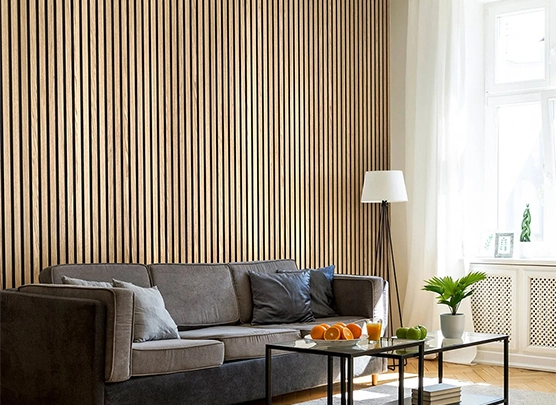
Unlike conventional acoustic treatments that may need to be hidden behind fabric or installed as separate technical components, PET wall panels can function as both an acoustic treatment and a visible interior finish.
This makes them particularly suitable for environments where acoustic performance and visual design need to be considered together.
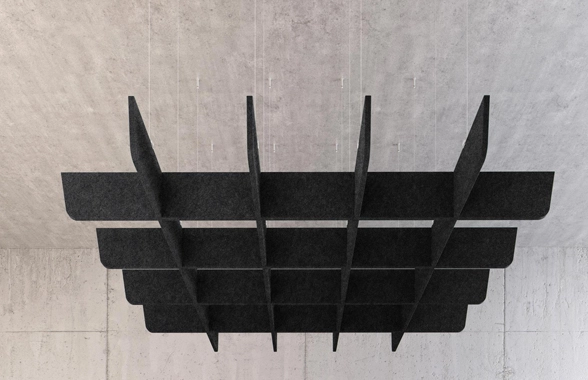
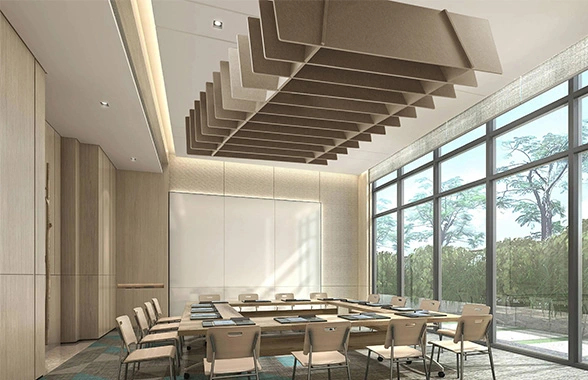
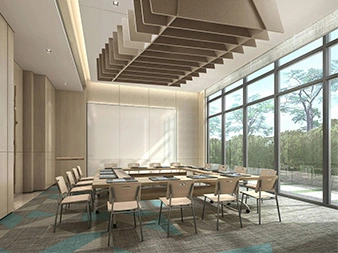
Acousound's PET acoustic range includes wall panels as well as ceiling baffles in different sizes and configurations, allowing designers to distribute acoustic treatment across different surfaces according to project requirements.

Panel thickness should not be selected only according to appearance.
Sound absorption depends on the physical properties of the acoustic material as well as how the panel is installed. A thicker panel can generally provide stronger absorption over a broader frequency range, but installation conditions also matter.
For example, placing an acoustic panel directly against a wall and installing the same panel with an air cavity behind it can produce different acoustic results.
Acousound provides PET acoustic panels in multiple thickness options, giving project teams flexibility when balancing acoustic performance, available wall depth, and visual requirements.
For a commercial project, the important question is therefore not simply:
"What is the NRC of this panel?"
A more useful specification question is:
"What panel thickness, coverage area, and installation method are appropriate for this room?"
A small meeting room with speech-focused acoustic requirements will not necessarily require the same treatment strategy as a large auditorium, restaurant, classroom, or open-plan office.
Wall coverage should follow the acoustic problem rather than an arbitrary percentage.
In a meeting room, reducing reflections around speaking and listening positions may be the main objective. In an open office, the designer may need to reduce the accumulation of conversational noise across a much larger area.
Classrooms have another priority: improving speech intelligibility so that students can hear teachers clearly throughout the room.
Restaurants often require a balance between atmosphere and noise control. Excessive reverberation can make conversations difficult even when individual tables are not especially loud.
Because these environments behave differently acoustically, wall treatment should be coordinated with room dimensions, surface materials, ceiling height, occupancy, and the location of major sound sources.
This project-specific approach produces a more useful result than simply applying the same panel layout to every room type.
One of the practical advantages of PET material is its design flexibility.
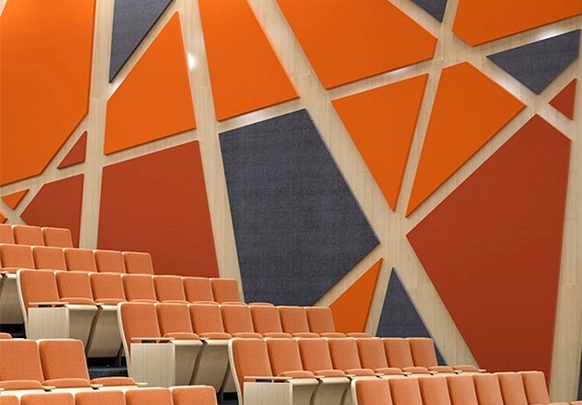
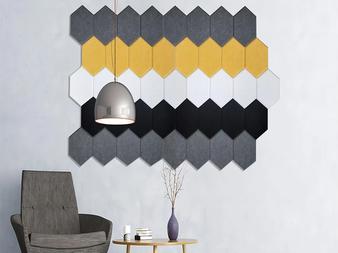
Wall panels do not need to look like conventional rectangular acoustic boards. They can be cut into geometric shapes, arranged into repeated patterns, combined into color compositions, or used as full-height architectural features.
This allows designers to use acoustics intentionally rather than trying to conceal acoustic treatment.
Acousound offers PET panels in multiple wall-panel formats and supports customization of shapes, dimensions, colors, surface treatments, and other visual details.
| Design Objective | Possible PET Wall Panel Approach |
|---|---|
| Minimal commercial interior | Large-format panels in coordinated neutral colors |
| Branded office | Custom colors or patterned acoustic features |
| School or childcare space | Geometric shapes and varied color combinations |
| Meeting room | Focused wall treatment around reflective surfaces |
| Hospitality project | Decorative panel layouts integrated with interior finishes |
The acoustic surface can therefore contribute to both the technical and visual language of the space.
Commercial acoustic materials are normally evaluated differently from decorative products intended only for residential use.
Architects, contractors, and distributors may need documentation related to fire performance, material composition, emissions, sustainability, and relevant building requirements before approving a product.
For project procurement, buyers should request the actual documentation required by the destination market rather than relying only on general product descriptions.
This is especially important for schools, healthcare buildings, corporate projects, public facilities, and other environments where material compliance can be part of the approval process.
PET wall panels are not always the only acoustic treatment required.
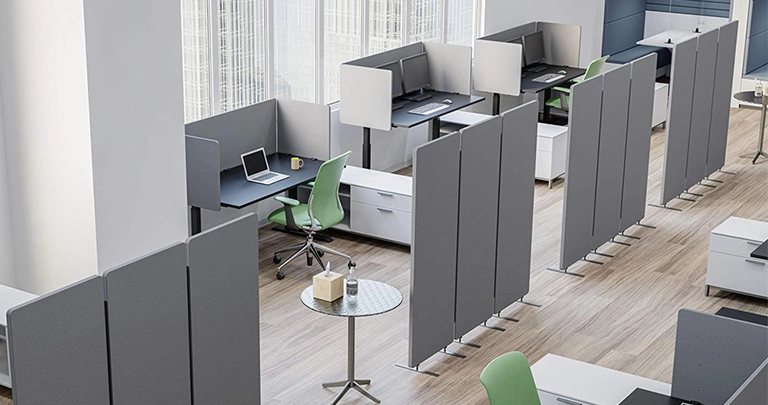
A room with limited available wall area may benefit from suspended ceiling baffles or acoustic clouds. A large open office may combine wall panels with desk screens or freestanding partitions. In spaces with high ceilings, treating the ceiling can sometimes provide significantly more available absorption area.
The best solution is therefore often a combination of surfaces rather than relying on one product type.
Wall-mounted panels are particularly useful when large reflective walls contribute to reverberation, ceiling installation is restricted, acoustic treatment needs to become part of the interior design, or accessible installation and replacement are important.
Ceiling baffles may be more suitable when wall space is occupied by glass, shelving, displays, doors, or other architectural elements.
The correct choice depends on the room rather than the product category alone.
For a commercial project, product selection should start with the room and installation conditions.
The supplier should understand the dimensions of the space, intended application, required panel thickness, desired colors, installation method, fire-rating requirements, and approximate quantity.
For custom work, drawings or reference images can make the specification process much more efficient.
Samples are also valuable. Acoustic panels are visible interior materials, so architects and buyers often need to evaluate color, texture, density, and finish physically before approving a large order.
Acousound manufactures PET acoustic materials for commercial acoustic applications, including wall panels, ceiling baffles, decorative acoustic products, office partitions, and customized acoustic solutions.
Its PET wall panel range can be adapted to different project dimensions, thickness requirements, colors, and design concepts. For architects, distributors, contractors, and commercial project teams, this makes it possible to coordinate acoustic performance with the visual requirements of the interior.
For projects requiring non-standard shapes, dimensions, surface patterns, or other design features, Acousound also provides custom acoustic solutions.
Instead of selecting a wall panel only by appearance, project teams can evaluate the material as part of the complete acoustic design: where sound absorption is needed, how much treatment is required, how the panels will be installed, and how the finished wall should look.
Not exactly. PET acoustic panels primarily absorb reflected sound inside a room and help reduce reverberation. Soundproofing usually refers to reducing sound transmission from one room to another, which typically requires different construction methods involving walls, doors, glazing, insulation, and structural assemblies.
Yes. PET material can be manufactured and cut into different dimensions, shapes, colors, and decorative configurations. Customization is especially useful for architectural and branded commercial projects.
The appropriate thickness depends on the required acoustic performance, room conditions, installation method, available space, and design requirements. A project should therefore be evaluated as a complete acoustic environment rather than selecting thickness from appearance alone.
Typical commercial applications include offices, conference rooms, schools, auditoriums, restaurants, healthcare facilities, studios, hospitality interiors, and other spaces where reverberation or speech clarity needs to be improved.
For architectural projects, samples are recommended because they allow designers and buyers to confirm physical color, texture, density, and surface appearance before approving production.